Overview
Clinical Dermatology & Cutaneous Science provides primarily a consultative service in addition to very active Ambulatory
care programs located within the Clinics, Treatment Areas and Phototherapy Unit. Dermatology
admits their in-patients under the Internal Medicine service. Dermatologists act as consultants on these
patients to oversee their Dermatologic care.
The Division of
Clinical Dermatology & Cutaneous Science
is composed of 11 staff dermatologists, 2 dermatology residents,
2 secretaries, 2 phototechnicians, 2 RNs, one LPN, one clinic aid, 2 booking & registration
clerks, 1 divisional manager and 1 nurse manager.
This very dynamic, cohesive group is situated on the fourth floor of the Dickson
Building, Victoria General Hospital site of the QE II Health Sciences Centre.
Medical students at all levels and residents from Family Practice, Internal Medicine, Pathology and
Plastic Surgery rotate through this subspecialty.
Staff Dermatologists and Graduate Resident Dermatologists
This is a small division, there are only two full-time hospital based dermatologists with
nine community based physicians. The contributions of the community-based dermatologists
play an integral role in the various divisional activities. Our very successful residency
training program was started in 1981. To date all residents trained at Dalhousie have passed
their Fellowship examinations. These results demonstrate that we have one of the best
training programs in the country.

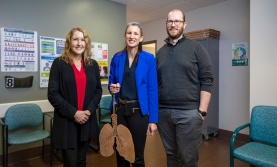
Dermatologists, Dermatology Residents and Support Staff
Clinical Services
There are nine, one half-day clinics running throughout the week. Several of these clinics
have two dermatologists working together. There is a combination of pediatric (three
a week) and adult clinics. There are subspecialty clinics which include: surgery clinics,
cutaneous T cell lymphoma clinics and a leg ulcer clinic. All students are provided opportunities
to take an active part in these clinics. They are encouraged to see new consultations, devise a
plan of approach and to carry out any procedures necessary. The technical procedures include: skin
biopsies, local excisions, electrocautery, cryotherapy, patch tests, and skin scraping to name a
few. Over 1600 various procedures were performed in 2000. The dermatologists saw approximately
1300 new patients and provided follow-up care in 3340 visits in this same year.
The Division of
Clinical Dermatology & Cutaneous Science
is very active in the area of Telemedicine. This program was
established in 1996 and continues to evolve in response to the acceptance of the technology
and needs of Nova Scotians. There are two telemedicine consultation clinics a week, where the
patients are provided scheduled dermatology appointments in their local hospitals. Their
hospital site computer links up with the QE II computer and the consultation proceeds from
there. This is a valuable learning tool for all students, and provides an opportunity for
residents in Family Practice to see how long distance medicine is actually used to complete
consultations.
The QE II Health Sciences Centre Phototherapy Unit is the largest one of its kind east of
Montreal. The unit provides approximately 9500 series treatments per year and the treatments
include: oral PUVA, bath PUVA, local PUVA, narrow band UVB, broad band UVB, UVA plus bath,
UVL for scalp and phototesting.
The Dermatology Treatment area has two full time nurseswho treat those patients with
severe skin disease, psoriasis and various forms of eczema to name a few. Treatments
include special baths, topical creams, dressings plus or minus UVL from the phototechnician.
They provide approximately 6500 series visits per year.
A remote phototherapy unit is currently monitored through telemedicine, New Glasgow has a
narrow band UVB/PUVA cabinet and a hand and foot unit. The UVB light unit but does not have
a local dermatologist to oversee treatments and manage
dermatological conditions.
There is an active consultation service in Dermatology for the surrounding hospitals. The
average is between 200-300 consults/year.
Education
Undergraduate program in Dermatology: Dr. Peter Green is the director of the
undergraduate program. The following is an overview of the Dermatology course at Dalhousie
University.
Second year: There is a series of 12 formal lectures given by the members of the Division.
There is exposure to simulated cases as well. This gives the student a chance to practice
histories and physicals in a quiet, non-intimidating environment. There are an extra 6 hours
of Dermatology which may be used for formal lectures, COPS cases or for in-depth review of
certain topics. This will vary from year to year.
Third and fourth year: There are elective and selective rotations offered. These are either
3-4 weeks depending upon the program or make up part of the clinical clerkship in medicine.
At any point in the undergradate program, individual students can arrange an elective with
a particular staff dermatologist. There are very limited spaces for this. There have
been research positions for summer students over the years.
Postgraduate program: There are elective rotations available for residents at the QE II.
There are a maxmium of 2 Dermatology resident training positions. Dr. Peter Green is the
Postgraduate Dermatology Program Director as well.
Research
Our Division is very active in Research. We have one dermatologist, Dr. Richard Langley who is
30% research. He has many areas of interest, these include: psoriasis, atopic dermatitis,
melanoma, cutaneous T cell lymphoma to name a few. Dr. Langley has acquired for his research
a confocal laser. With a confocal laser, he is able to see through the skin without taking a
biopsy for diagnostic purposes!!!